
Knee pain can limit walking, stairs, work, exercise, sleep and independence. Dr Oludolapo Sotade is a specialist orthopaedic surgeon who assesses knee pain and knee arthritis at Summit Orthopaedics in Toowoomba, with a particular focus on hip and knee replacement surgery.
Treatment depends on the diagnosis, the parts of the knee involved, symptom severity, alignment, ligament function, medical health and personal goals. Not every painful knee needs an operation, and an X-ray finding alone is not a reason for surgery.
The purpose of assessment is to identify the pain source and discuss proportionate options. Robotic or computer assistance is a surgical tool, not a guarantee of a particular result.
Pain limiting walking, standing, work, exercise or sleep
Swelling, stiffness or loss of movement
Pain with stairs, rising from a chair or uneven ground
True locking, recurrent catching or inability to fully straighten the knee
Progressive bow-legged or knock-kneed alignment
Symptoms continuing despite physiotherapy, medication, bracing or injections
Referral for total, partial or robotic-assisted knee replacement assessment
Knee osteoarthritis is loss of cartilage from one or more compartments of the knee. It may affect the medial, lateral or patellofemoral compartment and can cause pain, swelling, stiffness, reduced walking tolerance and deformity. Symptoms do not always correspond directly with the appearance of an X-ray.
Meniscal tears may follow an injury or occur as part of age-related degeneration. Many improve without surgery. The significance of a tear depends on the history, examination, presence of arthritis and whether there are persistent mechanical symptoms such as true locking.
Pain may also arise from the kneecap joint, tendons, bursae, referred hip or back pain, inflammatory disease, infection or less common bone conditions. Assessment is directed by the clinical pattern rather than imaging alone.
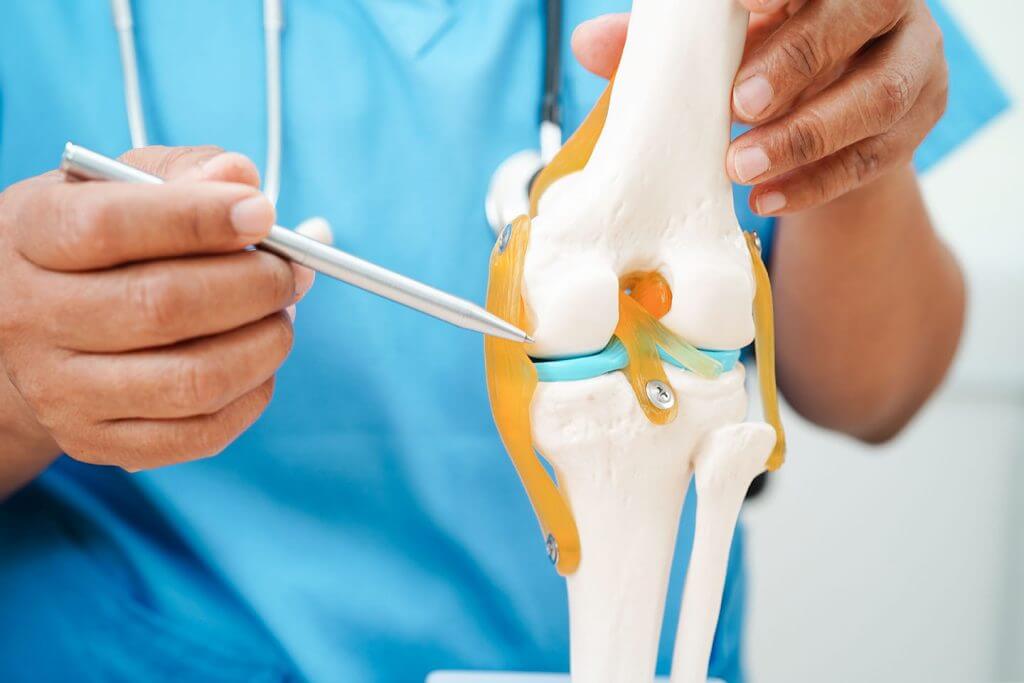
Assessment includes symptom onset, swelling, mechanical symptoms, walking tolerance, previous treatment and medical history. Examination considers gait, alignment, range of motion, joint-line tenderness, ligament stability, patellar tracking and hip function where relevant.
Weight-bearing knee X-rays are usually the most useful first test for arthritis. MRI may be appropriate when symptoms suggest a meniscal, ligament or cartilage injury and the result is likely to change management. MRI is not routinely required before an arthritis consultation.
Education, activity modification and pacing
Exercise therapy or physiotherapy for strength, movement and balance
Weight management where relevant
A walking stick, brace or unloading support in selected cases
Paracetamol, topical treatment or anti-inflammatory medication when medically suitable
Injection treatment for selected patients, recognising that benefit varies and is usually temporary
Total knee replacement resurfaces the major articular surfaces of the knee with metal and polyethylene components. It may be considered for advanced arthritis affecting several parts of the knee when pain and disability remain unacceptable despite reasonable non-surgical treatment.
Partial knee replacement resurfaces only the affected compartment. It is suitable for a selected group of patients with disease confined to one compartment, appropriate alignment and functional ligaments. If arthritis is more widespread or the knee is unsuitable, total replacement may provide the more reliable option.
Robotic-assisted and computer-assisted systems provide planning and intraoperative information to support bone preparation, alignment, component positioning and soft-tissue assessment. The surgeon remains in control throughout. These technologies may improve the consistency of technical measurements, but they do not guarantee a better outcome, faster recovery or longer implant survival for an individual patient.
Knee arthroscopy is keyhole surgery used for selected mechanical problems, including some repairable traumatic meniscal tears, loose bodies or persistent true locking. Arthroscopy is not a routine treatment for pain caused by established degenerative osteoarthritis.
The aim of knee replacement is to reduce arthritis-related pain and improve function. A replaced knee is not the same as a normal knee. Some patients continue to notice stiffness, kneeling discomfort, swelling, altered sensation or residual pain.
Risks include infection, bleeding, blood clots, wound problems, stiffness, nerve or blood-vessel injury, fracture, instability, persistent pain, implant wear or loosening, and further surgery. Personal risk is influenced by health, weight, smoking, diabetes, medications, bone quality and previous surgery.
Patients commonly stand and walk with physiotherapy on the day of surgery or the following day. Early priorities are swelling control, full knee extension, progressive bending, safe walking and quadriceps activation. Function often improves over 6–12 weeks, with strength, endurance and confidence continuing to develop for 6–12 months.
Return to work, driving and recreation varies. It depends on the operated side, occupation, vehicle, pain, medication, movement, strength and ability to perform an emergency stop safely. Individual advice is provided during follow-up.
Review of symptoms, health, previous treatment and goals
Examination of gait, alignment, movement, stability and related joints
Review of weight-bearing X-rays and other relevant imaging
Discussion of exercise, medication, bracing, injection or monitoring options
Discussion of arthroscopy or knee replacement only when clinically reasonable
A GP or specialist referral is recommended. To arrange an appointment, contact Summit Orthopaedics or complete the new-patient registration form. Consultations are held at Suite 61, St Andrew’s Toowoomba Hospital, 280 North Street, Rockville QLD 4350.
Total knee replacement resurfaces the major knee compartments. Partial replacement treats one compartment only. Suitability depends on the distribution of arthritis, alignment, ligament function and patient factors.
No. Robotic assistance is one method of planning and executing parts of the procedure. Suitability depends on the patient, implant system, anatomy and planned operation.
Not usually for established arthritis. Weight-bearing X-rays are generally more useful initially. MRI is reserved for selected questions that may change treatment.
No. Many degenerative tears improve with rehabilitation and time. Surgery is considered selectively, particularly for repairable traumatic tears or persistent objective mechanical symptoms.
Recovery is progressive rather than fixed to one date. Many daily activities improve over 6–12 weeks, but strength, swelling and confidence may continue to change for up to a year.